Friday, March 16, 2007

Grace builds on nature.

The monks invented the first schools. They were called "the school of the Lord's service." The subjects they taught were Reading, Writing, a little Arithmetic. . . . and Philosophy. Philosophy for young children? Yes, because it is when they were young that parents sent their children to monasteries. And having the natural God-given aptitude to reason rightly they were trained before they were ruined by worldly education. Those first subjects were very helpful in preparing for the study of Divine Revelation or Scriptures, because grace builds on nature.

Man is a rational animal. First an animal, second rational. Today he seems to be more animal than rational. Thanks to the information highway that has trapped men's mind on things earthly, preventing him from being rational and from rising up to the supernatural.

Today, the world is filled with evil and, as a consequence, sufferings. Religion must be able to explain why this is so because human knowledge cannot. For us Christians, we have to examine what happened in heaven and paradise once upon a time.

In paradise, man was meant to subdue his animal nature by what was rational in him, namely his intellect and free will. This was frustrated because of the Fall. So now, before he can do this, he must develop his intellect in the natural level through right and sound reasoning. Doing this will enable him to rise to the concept of a prime - mover or creator. Even in the natural sphere he could intellectually suspect that there is a supernatural sphere. His natural quest for this sphere will make him responsive to the grace of God and enable him to rise up to the supernatural. In this level he will discover that God spoke; and that what he said is found in Divine Revelation. With sound reasoning and Divine Revelation he can now dictate to his own free will the good he must pursue. Every decision he makes must now conform to this objective norm to do good.

St. Thomas of Aquinas gives the example of a carpenter who has a ruler. If he uses this tool, he will draw a straight line, his act would be considered right. Comparatively, if we love God more than anything else, then we are acting morally, according to the Divine rule of conduct which states that we should love God above all things. If we disregard this objective norm of judgment, Divine Law and sound reasoning, then it is our concupiscence that would be making the rules on what is straight or moral.

The Holy Father has often described the above scenario and called it the dictatorship of relativism. It is a cruel dictatorship because it is the rule of what is animal within us, as pictured imaginatively in the Planet of the Apes, except that the apes are within us.

A solution has been given by Pope Benedict XVI. We have to use sound reasoning, with a little help, perhaps, from the rules of logic formulated by the Greeks; and with the help of the virtue of Faith, find out who is this God who moves all things. Then we shall find out if that God has spoken, and find out what He has said. Our sound reasoning and what He has said should be our basis for judgment.

Unfortunately, Ronald Knox has observed that man, in his pride, has always been unlucky in guessing who that God is, an unconscious way of denying God in order to substitute himself in His place, as the first angels tried to do and became devils.

In the dictatorship of relativism, we make up the norms, thus making ourselves "like unto God." Wasn't this the temptation of Adam and Eve? And we have fallen.

St. Thomas of Aquinas, following St. Augustine, described an act as evil, when it does not follow the external norms put forward by Divine Revelation and sound reasoning. This would mean that the world, especially now, is filled with evil. To be good or holy today would be most difficult. Perhaps this is why it has been prophesied that the saints of the last age would be greater, because inspite of the great evil of our present age, evils that have not been seen in ages past, they will be able to reach holiness. What about those who find evil insurmountable? Well, we should believe that where there is an abundance of evil, there will always be a superabundance of grace.

This present moral state was already described by William Shakespeare with words uttered by Marc Anthony at the funeral of Julius Caesar who was assassinated by Brutus and his friends. "O judicium, ad belvas fugisti brutas. Atque homines rationem perdiderunt." (O judgment, thou art fled to brutish beasts, and men have lost their reason.) (Painting by Master Francke, "The assassination of St. Thomas Becket," fifteenth century.)

Tuesday, March 06, 2007

NEW EMERGING LAY COMMUNITIES


Pope John Paul II, of holy memory, and our present beloved Pope Benedict XVI, both have shown great interest in the new movements among the laymen. They used to attend the meetings of these lay movements in Rome. Thus, a Congregation has been set up to regulate and monitor their activities. The Cursillo in Christianidad, in which I had been very active in the early years of my priesthood, has just received Vatican recognition. Pope Pius XII was the first to notice this movement in the Catholic Church, and inspired by it, encouraged its development and instructed Bishops to cooperate in what he thought was a clear movement of the Holy Spirit within a troubled Church.

This is not new. In the history of the Catholic Church, whenever the Church needed renewal, God raises laymen to renew her. St. Francis of Assisi would be a classic case. And while there were great figures who dominated the renewal scene, a strong undercurrent of lay movements was present everywhere. It was this fact that made Pope Pius XII notice the emergence of lay movements in these times, like the Opus Dei, Cursillos, Focolare, etc.

Let us look at a brief moment in history and make an important observation. Circa 900 A.D. was described as the Dark Ages for civilization and calamitous for the Papacy with Rome in turmoil. Immediately evident was the reform in the Ecclesiastical level with St. Peter Damian, a Benedictine, beginning his reform around the year 1000 A.D. which begun the Ascent and Descent Chapter of the history of the Church. St. Peter Damian's reform was carried on by the Gregorian Popes initiated by Pope Gregory VII, a Benedictine. The reform was further enhanced by a movement from Cluny, a Benedictine Abbey that was ruled by four consecutive saintly Abbots. Further on we see St. Dominic de Guzman in the middle of the frey. The Church never lacked holy Popes and Saints to sustain the Church.

But note that from the time of St. Peter Damian to St. Dominic, for instance, there was a very strong lay movement where these groups lived in imitation of the first Christians as described in Acts of the Apostles. These laymen were living lives that put the clergy to shame. These lay movements may be divided into two groups. First, those who lived as the first Christians did using Scriptures as their only guide, especially the Acts where the first Christian communities were described by Luke. And secondly those who did exactly the same thing but placed themselves under a Rule. Though the Rule of Saint Benedict was the favorite, around the time of St. Dominic the Rule of St. Augustine became popular. The observation is this: those whose only guide was Scriptures easily strayed into heresy. While those who were guided by a Holy Rule as well continued in their orthodoxy.

Today, we have many similar lay movements, but most of them are depending completely on Scriptures alone for guidance and the private interpretation of Scriptures of their founders. They are in danger because the sources of Catholic teaching is both Scriptures and Tradition plus the Magisterium of the Church. The Holy Rules specify how the Gospel is to be lived. To depend on Sola Scriptura, even if it is the Bible, is definitely dangerous; "Beware of the man with one book," warns St. Thomas of Aquinas. Pope Benedict XVI has often hinted on the use of the Rule of St. Benedict as an added guide. He could also suggest the Rule of St. Augustine, being a lover of the saint, or other Rules as well. But St. Benedict's Rule, having been the main force in the conversion of pagan Europe, is what we probably need in our present time since we have returned to paganism. (Painting by Sodoma "Stories of St. Benedict," 1503.)

Friday, February 23, 2007

The SECRET of Fatima


There is much controversy regarding the secret of Fatima. Of course we must be interested in it.... the Blessed Mother has spoken! The Church has decreed that she has spoken indeed. We must find out what she said. It was addressed to mankind. How come few know about it? Even many priests and bishops are ignorant of it.

Pope Benedict XVI, as Cardinal, described it as nothing else than what is found in Scriptures. And he was right. Except few really understand Scriptures because its meaning is supernatural, unknown by the natural man but understood only by the spiritual man.

The Secret of Fatima was explained by Pope John Paul ll at Fatima, during the canonization of Jacinta and Francisco. But nobody understood it. And so it is not that the Church has not explained it publicly, but rather that nobody understood it.

There is nothing in private revelations that should not be already found in public or Divine revelation. And the secret of Fatima is found there.

It is found in the Apocalypse, the similitude used by Pope John Paul II in Fatima. But then the Apocalypse is the most difficult book to interpret. No wonder no one understands it. This same message is taught in the tradition of Benedictine monasticism. It was popularized by Joachim of Fiore and became part of the Franciscan tradition, too. St. Bonaventure was interested in it as noted by then Cardinal Ratzinger in his thesis the "Theology of History according to St. Bonaventure."

Countless saints have written on it, like St. Louis de Montfort. In fact it was on this Benedictine Tradition that he built his writings and founded his Congregations.

And so when Pope John Paul II and Cardinal Ratzinger announced the message at Fatima they put their heads together. Cardinal Ratzinger was knowledgeable of Scriptures, the Benedictine Tradition as written in the Dialogues of St. Gregory describing the life of St. Benedict, and the Franciscan Tradition as compiled by St. Bonaventure. Pope John Paul II knew the writings of St. Louis de Montfort since he was a young priest, from where he got the motto of his coat of arms "Totus Tuus."

And what is the message of Fatima? "It has begun." As St. Thomas of Aquinas has said, for those with Faith no explanation is necessary. But for those without faith, any explanation is futile. (Painting is "The Immaculate Conception" by Giovanni Battista, 1714)

Thursday, January 25, 2007

The DE-CHRISTIANIZATION of the CATHOLIC CHURCH

By default, the Catholic Church is undergoing a de-Christianization. Catholics and their descendants are no longer making their acts of faith.

The cause is the fact that an act of Faith is a purely supernatural act. And man today is so natural (and unnatural) that they are unable to climb up to the supernatural. Or, even though the act of Faith is purely an act of God, man is unable to dispose himself to deserve it. Unfortunately, our culture and our times, our system of Catholic education and our defective catechesis, and our parents all contribute to our present indisposition.

So what is happening is that Catholics with faith are losing their faith because of sins against faith and our young ones are unable to make their act of faith because of the bad examples around them. Blessed Alberione, in fact, put the blame on parents, particularly the mother. Our mothers are more like Eve than the Blessed Virgin Mary. Unlike Mary who brought Christ to the temple, mothers are bringing their children to the forbidden tree. Should we still wonder why we are killing one another as Cain killed his brother Abel?

And it is the children of Eve who are becoming priests and bishops, nuns and future mothers. Where are the true children of Mary? The book of the Apocalypse points at the desert where the woman fled to a special place prepared by God Himself. There, in that special place, is where the true children of Mary are to be found.

St. Louis de Montfort knew this and tried to establish a community that would truly become children of Mary, truly a community of Faith. St. Bonaventure knew about this, too, and was hoping that that community was that of St. Francis of Assisi. Pope Benedict knows about this "small Church" shining with true Catholic Faith, which, perhaps, explains his interest in new emerging small communities.

Christ has prophesied that "when the Son of man comes, will He find Faith on this earth?" Of course there will always be, for the Church will always exist. But He emphasizes its smallness.

Sion, and especially the temple of Jerusalem, pre-figured the Catholic Church. Because of the unbelief of the Jewish people the temple was destroyed, wherein "not one stone was left on top of another." Could this be the same vision at Fatima: the ruined Church wherein not one stone is left on top of another .... because of her de-Christianization, because of her absence of Faith?

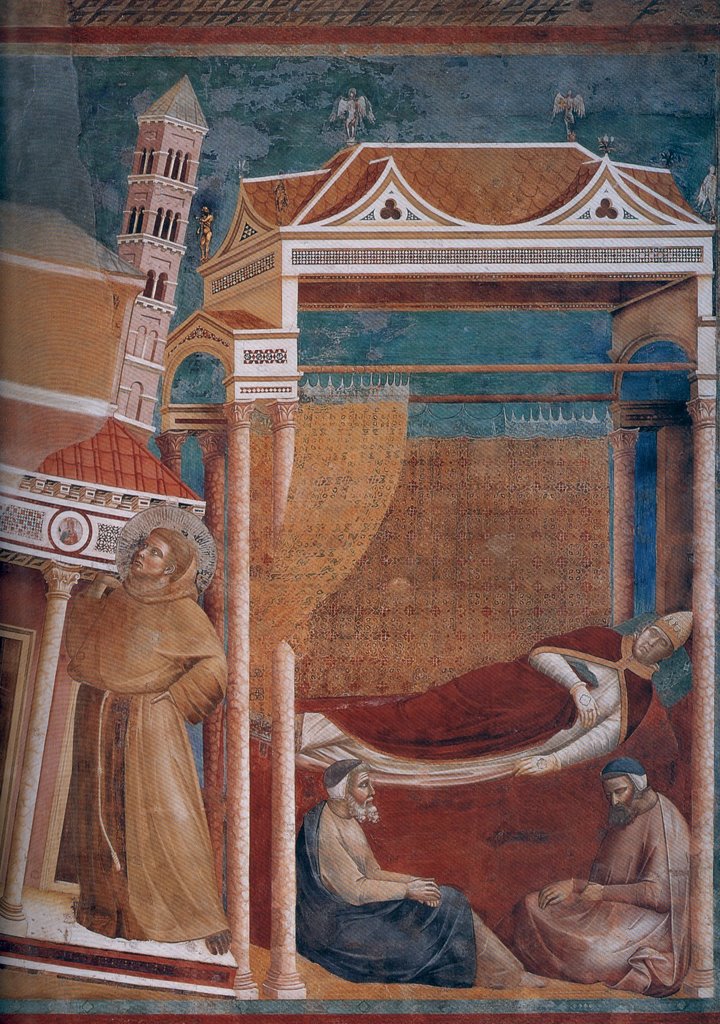
Only those with Faith can transmit the faith, says Leo XIII addressing exegetes. We have had a crisis of faith since the middle ages. With faith practically dying with the Saints raised by God, the world would be devoid of it by now. Of course, God always raises up Saints and Popes to confirm us in the faith, but who gives their intellectual assent to their teachings as words of God? (Painting is "The Dream of Innocent III" from the Basilica of St. Francis.)

Thursday, January 11, 2007

WIELGUS AFFAIR - a bishop treated unCHARITABLY

I am still struggling with two articles in my draft. One on the absence of faith and the second on the de-Christianization of the Catholic Church. Both articles show the absence of the theological virtue of Faith among many Catholics.

Living Faith, however, must be enlivened with Charity; otherwise it is dead. Then comes the sad Wielgus affair that fortifies the above thesis. His treatment by the people shows a great lack of Charity in them.

Our analysis has two parts. The first part, what Bishop Wielgus did and the second part, the reaction of people who urged the good bishop to resign before his installation. I am unqualified to handle the first part for the same reason that those who rejected him were not qualified to judge the Bishop.

The first part is between the Bishop and God. A moral analysis of the second part shows that the people who urged him to resign were unjust if not uncharitable and guilty of mortal sin commonly called rash judgment "Judge not that you may not be judged." The words of Christ were threatening, showing the seriousness of the sin. Our concern is not whether the bishop is guilty or not. But whether the unfavorable reaction was Christian or not.

Let us go to the second part. Judgment is an act of Justice, a decision of what is just and right. To judge rightly proceeds from a virtuous habit. A chaste person decides matters relating to chastity; to what is just belongs properly to Justice. We may judge but not rashly. We may judge as long as it is an act of Justice.

But Justice is a moral virtue that accompanies the theological virtue of Faith enlivened with Charity. Only one in the state of Sanctifying grace, practically a saint, can judge with wisdom and with prudence (both a supernatural state) comforming with the ruling of the Gospel.

St. Thomas of Aquinas gives 3 requirements for an Act of Justice. Firstly, it must come from the inclination of the moral virtue of Justice in assistance to the theological virtue of Faith. Secondly, the judgment must come from a person in authority. And thirdly, the judgment is pronounced according to the right ruling of prudence. In the absence of any one element, the judgment is unlawful.

The violation of the three requirements would go thus: firstly, if the judgment is made by one in (the state of) mortal sin and therefore devoid of Justice, the judgment would be perverted or unjust. Secondly, if the judgment does not come from his superior, it is judgment by usurpation. And thirdly, if the judgment is not guided by the moral virtue of prudence (a supernatural moral virtue) then it is a rash judgment.

The first requirement was stated by Christ, "He who has no sin may cast the first stone." No sin... refers to being in the state of grace. Where those who objected to the bishop's elevation without sin? The fact that they rash judged him shows they were in the state of mortal sin since he is a Bishop. Because the bishop's dealing with the communist is not clear and labeled 'under suspicion', St.Thomas of Aquinas would have stated that to judge him is a mortal sin.

The second requirement: those who judged him were not his superiors. The immediate superior of Bishop Wielgus is the Pope. So when inferiors judged the bishop, it was perverse and by usurpation.

Besides, his promotion is of a spiritul matter and should not be ruled by human consideration. The spiritual is superior to the natural. The spiritual can judge the natural in its spiritual aspect but not vice versa.

The third requirement is that the judgment must be inspired by the moral virtue of prudence which exist only in those with living Faith, i.e. in the state of grace (which unfortunately everybody thinks he is). But the fact that they have disobeyed the commands of Christ "Not to judge," "Not to look at the speck," "To love," shows that they were not in the state of grace, they were in the state of sin and had no right to cast the first stone.

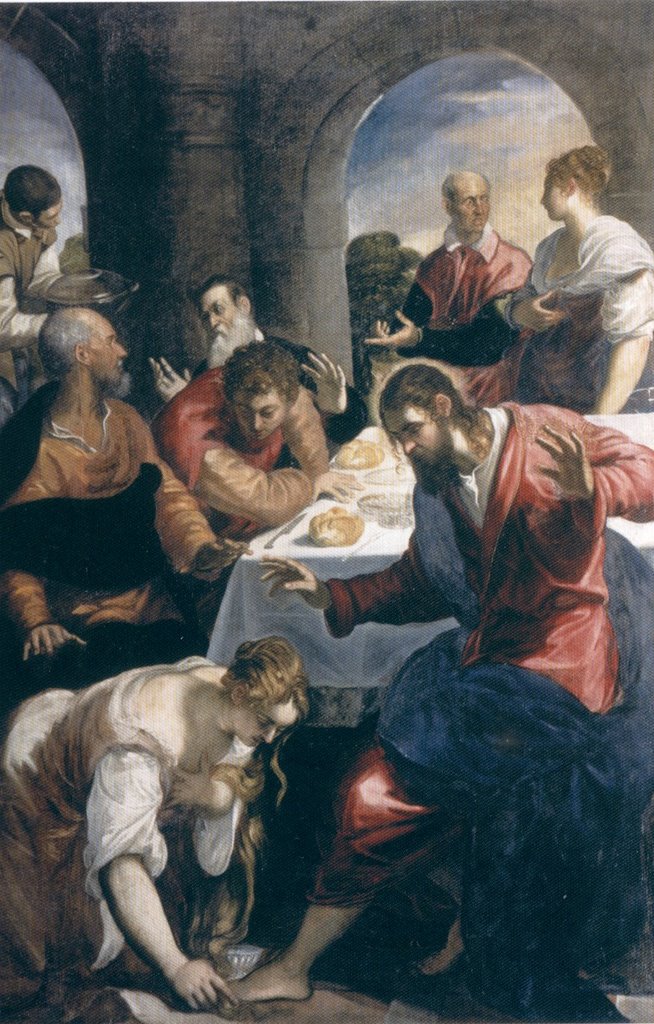
The Pope and the Congregation for the Bishops acted rightly and charitably. They knew the bishop, his background and acted according to the 3 requirements of St. Thomas and recommended his elevation to the see of Warsaw. The Pope is guided by Christ's promise of a strong faith; he is the superior of the bishop; and because Christ prays that his faith may not waver, he has prudence. The Pope's choice was in accordance to the teachings of Christ and the inspiration of the Holy Spirit, thus completely a supernatural act that surpasses all natural, judicial, political or experimental knowledge. Our shepherd has shown the way. If we have the Catholic Faith, we must be one heart and one mind with him and do likewise and agree to the installation of Bishop Wielgus to the See of Warsaw. (Painting by Tintoretto, 1519-94, "The Banquet in the House of Simeon.")

Tuesday, December 26, 2006

The Priest - Problem


I was amazed at the extent of the problem of many priests in the US: Sex. It is bad enough that seminary training since the past century is far from what the Holy Father would want it; they have been turning out priests who are not faithful to their vow of celibacy. But the problem has degraded even to unnatural sins: sex between two men or with minors.

Spiritual writers, like St. Thomas of Aquinas, have stated that in the spiritual life, one must progress every minute. St. Benedict described this as conversion of life. We must be converted continuously towards the perfection of Charity. They describe this as the three stages of conversions which we must undergo in the spiritual life. He who does not progress, deteriorates, St. Thomas of Aquinas states.

Let us look at the normal pace and direction of the Spiritual life towards the perfection of Charity. Let us start with children. They are born with a tendency to choose evil, the original sin we inherited from our first parents. But this tendency matures only at the age of reason. So before they lose their initial innocence, parents, god-parents and the Church should raise them to the supernatural level through Baptism and an act of faith, just as the parents of St. Therese did. From then on, the child grows in nature. But he should also grow in grace; this way he will not have much problem with regard to the devil, the world and the flesh. But if he does not grow in grace, these three enemies of the soul will bother him and cause him to sin. In which case he would need the sacraments of Penance, and perhaps of Matrimony. If he continues to grow in grace after Matrimony his journey will be smooth. If he does not grow in grace, he could commit adultery. Many remain in that sinful state. If they get worse, they could easily enter into other vices like avarice, gluttony, etc.

Now, let us go back to the seminarians. Like all children, after baptism, they had within themselves the spiritual tools to progress in the life of grace up to the perfection of Charity. But if their parents had neglected their growth in grace they could be unprepared for seminary life. If within the seminary, their life in grace is neglected, their concupiscence could start to act up. They would be attracted to girls. But since there are no girls in the seminary they could begin with self-inflicted impure acts. If they do not overcome this by ascetical exercises, they could tend to desire these impure pleasures from others. And since they are surrounded only by men, they could be attracted to each other. But because of "whistle - blowers" they could prey on children, instead. This is just the application of the above principle of spiritual life, "He who does not progress will regress." While great efforts are needed to progress, no effort is needed to regress.

Ignorance of the workings of grace and the spiritual life while living in the purely human level (in short, the absence of growing up in true Faith) is the cause such a problem.

Catholicism is the answer and solution to all problems from drug addiction to adultery; more precisely, monasticism. Didn't monasticism solve all the problems of Europe, transforming that pagan continent into a Christian one? And wasn't the neglect of monasticism that caused the return to paganism? Didn't Pope Benedict hint a return to St. Benedict's monasticism?

The "gay" problem had been tackled even as early as the time of St. Basil. He had such problems with his first followers who were new converts from paganism and who could still easily regress. St. Peter Damian discussed this problem lengthily and his solution was the monastic life.The Gregorian reform initiated by Pope Gregory VII was an attempt to stem this scourge among others. It is a problem that cannot be solved unless the individuals concerned take the initiative to grow in the spiritual life. Peter Damian, also a Benedictine monk, imposed both the rule of St. Benedict and St.Romuald in order to show the greater need to lead a stricter than the ordinary monastic life. (Painting is "Basil and Emperor Valens" 1st half of the 18th century by Pierre Hubert Subleyras.)

Wednesday, December 13, 2006

OUR LADY OF GUADALUPE

Here in our monastic community we had been busy preparing for the celebration of the feast of Our Lady of Guadalupe, the principal Patroness of the Philippines. A Solemn Pontifical Mass was concelebrated by two bishops and five priests, the choir singing the Gregorian Chant and Renaissance acapellas. After, the faithful partook a repast in the Oratory grounds.

The Church was to be described in three stages: first, in the old Testament Church, wherewith the people of God were set aside away from the rest of the people. The second, during the public life of Christ wherewith they were for a while in the world to listen to the Word of God. And thirdly, after Pentecost, when the Church returned to the desert.

These three stages are represented by the feasts during the Advent season. The first Sunday of Advent showed who were to receive God's favorable judgment; this is followed by the feast of the Immaculate Conception; and in preparation for the feast of Our Lady of Guadalupe, the feast of Juan Diego.

These stages describes the three degrees of Humility which is the breeding ground of the theological virtues of Faith, Hope and Charity. So we see the humility of Christ who was God but humbled himself to be a servant "I came to serve and not to be served." Then we see the humility of the Blessed Virgin Mary who was, though not a god, was somebody; but she humbled herself to be a handmaid of the Lord. And then, Juan Diego who was a "nobody" and called himself a nobody.

Evidently it would be difficult to copy the humility of a God who became man. It is easier to copy the humility of a human, though chosen to be the mother of God, who remained a human. But it is easier to copy the humility of a "nobody" Aztec who remained a nobody.

To be humble like Juan Diego consist in living the life of Repentance preached by John the Baptist and perfected by Christ. To be humble like Mary is slightly more difficult and consist in living the life of Repentance and having devotion to Mary. But to imitate the humility of Christ we must live the life of Repentance, be devoted to Mary and have her mediation to raise us up to be Christ-like.

In Scriptures, the first state is described in the old Testament and the beginnings of the New Testament. The second state is described in the public life of Christ. And the third state is taught to us after Pentecost. Thus in the second state Mary was Mother of Christ. And in the third she was the personification of the Church.

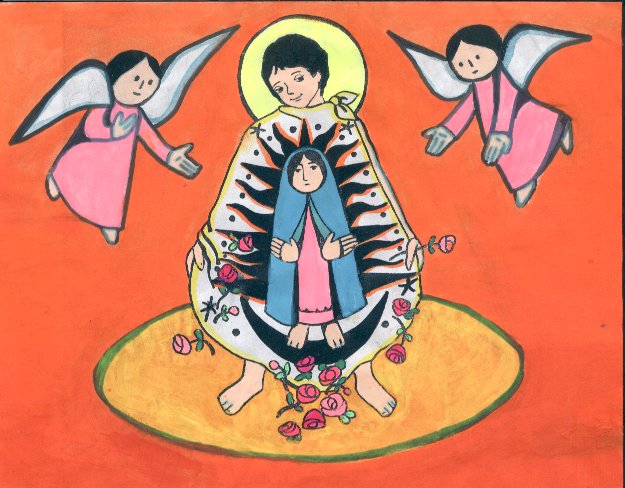
Thus Scriptures describe the Church of the Old Testament as Sion. In the New Testament the Church was described as the daughter of Sion or the New Jerusalem or the woman in the world. And the third was described in the Apocalypse as the Woman in the Desert...which resembles the image of Our Lady of Guadalupe.

Since the first and second stages are over, the Church has been focusing on the third stage wherein the Church, though primarily Christocentric, will take a Marian character. So the first Christians returned to the desert to learn the Christocentric aspect of the spiritual life. Attaining this, the fathers of the Church began adding devotion to Mary by honouring her with the title of the second Eve.

This Marianization of the Catholic Church gained ground in the times of St. Dominic and Bernard of Clairvaux. It disappeared for a while under the onslaught of the serpent but continued in the era of the renewal in France with Berulle, Olier and Louis de Montfort, who was so convinced of the Marian character of the Church (the Woman of the Apocalypse) that he established an order that would correspond to its description.

The 1400s and 1500s were years when Mary seemed to fortify this tendency by her numerous apparitions, with Our Lady of Guadalupe, being the most impressive of them all.

The three important truths that are the objects of Faith are: that there is a God; the second person became man; and that He redeemed mankind. In the act of Redemption, begun in the Old Testament, Mary plays an important part in the Incarnation (in which the description on how the Spirit overshadowed her and came upon her is replica of Pentecost) and in the end of our journey which is to be with God the Father in Heaven.